


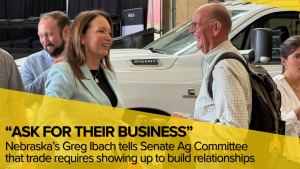
WASHINGTON — Greg Ibach, President Trump’s nominee for USDA undersecretary for Trade and Foreign Agricultural Affairs, told the Senate Agriculture Committee that expanding overseas sales will take more than signing trade agreements. It will take showing up, he said, and asking foreign buyers for their business.
Ibach, a fifth-generation Dawson County, Nebraska, producer who served 12 years as Nebraska’s agriculture director and as USDA undersecretary for marketing and regulatory programs in the first Trump administration, testified at his confirmation hearing last week. The committee also heard from three nominees to the Farm Credit Administration board.
Boozman: Trade Access “More Critical Now Than Ever”
Committee Chairman John Boozman of Arkansas opened by saying the trade post leads USDA’s trade promotion programs and international food assistance work, and ensures agriculture is prioritized in the administration’s broader trade discussions.
“We know that advancing market access for U.S. agriculture is more critical now than ever,” Boozman said. He described farm country as in a “very, very dire” situation, citing high input costs and low commodity prices, and noted that Arkansas leads the nation in farm bankruptcies. Boozman said he is working with ranking member Amy Klobuchar to advance a five-year farm bill before the end of the year.
Boozman said USDA is working to restore beef access in markets like China, that rice, seafood and specialty crop producers want a level playing field with imports, and that the ongoing review of the U.S.-Mexico-Canada Agreement is critical for agriculture. He said Ibach “will play a key role in all of those efforts.”
Fischer Introduces Fellow Nebraskan
Nebraska Senator Deb Fischer introduced Ibach to the committee. “Today I am just very, very honored to introduce a fellow Nebraskan and a good friend,” Fischer said.
“As a fifth generation producer, Greg has dedicated his life to ensuring farmers and ranchers can continue to feed and fuel the world,” Fischer said. She noted that Ibach helped open new foreign markets to Nebraska beef and agricultural products while hosting trade visits from international groups, and that the committee unanimously supported his 2017 nomination as undersecretary for marketing and regulatory programs.
“Greg has an impressive ability to build relationships between regulators, stakeholders and producers,” Fischer said, adding that she is “confident that Greg’s experience makes him highly qualified for this role.”
Ibach: “Persistence, Communication and Teamwork”
In his opening statement, Ibach thanked Fischer for her “kind introduction and steadfast support throughout this nomination process.” He described growing up on a row crop and cow-calf operation near Sumner, Nebraska, and said his family’s farm survived tough times “because of persistence, communication and teamwork.”
Ibach said he would bring “that same producer perspective and commitment to service to the critical work of expanding and defending markets for American agriculture around the world.” He said USDA “helps turn the productivity of American agriculture into real sales and stronger farm incomes.”
“If confirmed, I will prioritize aggressive market development and trade enforcement,” Ibach said. That means working with the U.S. trade representative, the Commerce and State departments, and U.S. embassies and agricultural attachés “to identify and remove barriers, whether tariff or non-tariff, that limit opportunities for U.S. agriculture. It also means standing firmly behind our producers when trading partners fail to honor their commitments.”
Shrinking the Trade Deficit
Boozman noted that USDA projects the agricultural trade deficit at $25 billion and asked Ibach where the biggest opportunities lie to bring it down. Ibach said recent trade agreements have helped.
“But I believe now we’re at a point in time when it’s going to take even more work as we continue to chip away at the ag trade deficit,” Ibach said. “And I think that means traveling, going to countries, talking about, our taking our agricultural producers and the commodity organizations that represent them with us to explain the quality of our food, the safety of our food, and the nutrition of our food and ask for their business.”
Ibach said the focus should include highly populated regions that cannot produce enough food for their own people, but also “smaller markets, to be able to diversify our opportunities and trade.” He said discussions with USTR about “free and fair trade” would be “a very high priority,” pointing to foreign barriers that keep U.S. products out and unfair practices that let competitors undercut American prices.
Rice and Level Playing Fields
Boozman, whose state produces much of the nation’s rice, said more than 30 percent of the rice consumed in the U.S. comes from overseas, and asked Ibach to work to ensure rice producers can compete on a level playing field.
Ibach recalled touring a rice processing plant as undersecretary and learning that USDA’s food-buying standards were higher than the standards for rice sold in grocery stores. “I went back to USDA and fixed that problem,” he said. “The core to that problem is fairness and having a uniform set of standards to be able to trade on.” He said that includes “making sure that there aren’t different standards for rice coming into the U.S. than what our growers face.”
The Warnock Exchange on Food for Peace
Georgia Democratic Senator Raphael Warnock focused on Food for Peace, which is being moved to USDA. Warnock accused the administration of hurting hungry children, wasting taxpayer dollars and harming American farmers, including Georgia peanut growers who supply the key ingredient in ready-to-use therapeutic foods.
Asked whether he knew the program buys food from American farmers, Ibach said he did. He recalled seeing peanut butter packets handed out to schoolchildren in Ghana while traveling with USDA as Nebraska’s agriculture director. “The nutrition that it provided was very impressive,” he said.
Warnock then asked whether such programs can help farmers struggling with tariffs and trade wars. “Absolutely,” Ibach said. “By getting our customers around the world that need food assistance used to the high quality, the nutritional content and the safety of our commodities. Hopefully when they get on their feet and their economies improve, they will be customers of the U.S. farmers and ranchers.”
The hearing’s most contentious moment followed. Warnock said the White House proposed eliminating Food for Peace in its 2027 budget request, calling it wasteful, and asked Ibach for a yes-or-no answer on whether the program should be funded.
Ibach: “It would be my obligation to follow the law.”
Warnock: “What do you think? It should be funded? I’m just asking your opinion. Do you — yes or no — do you think it should be funded?”
Ibach: “Food and feeding programs are important. Part of our humanitarian responsibility as U.S. citizens.”
Warnock: “So that’s a yes.”
Ibach: “Food and feeding programs are important.”
Warnock also asked how USDA, which lacks the staff and expertise of USAID, would handle the program. Ibach said he would seek out expertise, work with the secretary and administration “to make them aware of any needs” so the department can staff both feeding programs and trade activities, and consult the State Department. He said two TFAA leaders come from State and he would use them “as advisors.”
Warnock then asked whether Ibach would commit to deploying food based on need rather than using it to pressure countries into unrelated demands. “I will follow the law,” Ibach said. Warnock replied that nothing in the law stops the administration from deploying food, calling it “an immoral choice” by the administration, in his view. He added that he was “heartened to know that you will seek the expertise of folks who focused on this.”
Boozman: “A Tremendous Program”
Boozman struck a more upbeat note on Food for Peace. “Food for Peace is a tremendous program,” he said, and he said lawmakers will “get it figured out, get it in USDA and make it even more successful.” He noted the farm bill reported out of committee in September would permanently transfer the program to USDA.
If confirmed, Ibach would oversee both sides of the portfolio: finding paying customers for American agriculture and administering food assistance abroad. Boozman said the record will remain open until Thursday morning.