


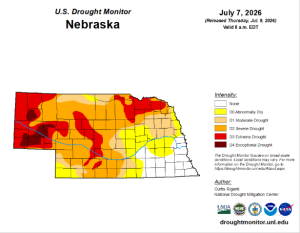
KEARNEY — Recent rainfall provided some relief from extreme drought conditions in portions of central Nebraska, although much of the state continues to face significant dryness.
According to the latest U.S. Drought Monitor, a narrow area stretching from Frontier County into Dawson County, south of the Platte River, improved from extreme drought, classified as D3, to severe drought, or D2.
Elsewhere, changes were limited. Moderate drought conditions expanded into portions of Platte, Colfax, Dodge, Cuming, Stanton, and Madison counties.
About 3% of Nebraska, all located in the Panhandle, remains under exceptional drought, the most severe category on the scale. Overall, approximately 88% of the state is experiencing some level of drought.
The U.S. Drought Monitor said conditions across the Great Plains varied during the past week as scattered showers and thunderstorms produced uneven rainfall totals.
Temperatures were generally near or above normal across the High Plains, with parts of eastern Nebraska running 3 to 6 degrees warmer than average.
Dry conditions also intensified in portions of eastern Nebraska, where precipitation and soil moisture deficits led to an expansion of abnormal dryness and moderate drought.
Heavier rainfall was reported in parts of northeast Colorado, northern Kansas, southwest and southeast Nebraska, and along the Missouri and Big Sioux river corridors. In some locations, those storms led to improvements in drought conditions.
The National Weather Service in Hastings said isolated thunderstorms are possible Friday, although many locations are expected to remain dry, and severe weather is not anticipated.
Mostly dry conditions and gradually warmer temperatures are forecast through the weekend and into the beginning of next week.