


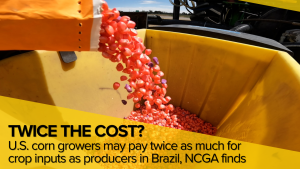
American corn growers say they have long suspected they were paying more for crop inputs than competitors in Brazil. A new economic analysis suggests the gap is even larger than many expected.
The National Corn Growers Association this week released a report comparing input costs paid by U.S. and Brazilian farmers, finding American producers routinely pay substantially more for seed and crop protection products despite competing in the same global grain market.
The study, conducted by market research firm Kynetec, found U.S. corn seed prices averaged a 68% premium over comparable products in Brazil from 2023 through 2025. The report also found U.S. corn insecticide prices averaged 87% higher, while many fungicide and herbicide comparisons showed American farmers paying nearly twice as much as their Brazilian counterparts.
“We knew there was differences, but did we think they were this big?” said Michigan farmer Matt Frostic, first vice president of NCGA and chair of the association’s Inputs Task Force. “There still brings a huge disparity between, say, your fungicides and seeds and insecticide prices.”
The findings come as many corn growers continue to struggle through a prolonged downturn in the farm economy.
“We’ve seen four years of negative margins in corn,” Frostic told the Rural Radio Network. “We’ve got to reverse the trend.”
The report argues the differences cannot be explained simply by currency exchange rates. After adjusting for purchasing power, Brazilian growers still maintained a significant cost advantage across many input categories.
Instead, researchers point to several factors, including product mix, market concentration, availability of generic products and regulatory differences between the two countries.
Brazil relies more heavily on lower-cost generic chemistries and single active ingredients, while U.S. farmers tend to use more premium products and multi-molecule formulations. Even so, Kynetec found meaningful price differences often remained when comparing similar active ingredients sold in both countries.
NCGA also contends regulatory policies can affect competition by influencing how quickly generic products reach the marketplace.
Frostic said the organization is not trying to attack input suppliers but instead wants to better understand why such large price differences exist.
“We’ve got to continue to work with these input companies in a constructive way,” he said. “We’re still partners and we’ve got to work through this.”
The association has also criticized the growing use of trade remedy petitions affecting agricultural inputs. NCGA previously opposed tariffs on imported phosphate fertilizer and 2,4-D herbicide supplies and is now raising concerns over Bayer’s recent petition involving imported glyphosate.
“Companies are now using trade remedy laws to consolidate their market share and increase prices even further,” Frostic said in a statement. “If this trend continues, input providers will force their own customers out of business.”
The report places the findings within a broader competitive landscape as Brazil continues expanding grain production and investing heavily in rail, ports and other export infrastructure.
“The American farmer’s selling a bushel of corn on the world market for the same price as everyone else,” Frostic told the Rural Radio Network. “That is really hard to soak up that differential and stay competitive in the market.”
NCGA is calling for greater pricing transparency from input suppliers and says input costs should become part of policy discussions involving farm programs, trade, biofuels, competition and regulation.
The association also argues U.S. farmers face an uneven competitive environment because Brazil maintains trade barriers on American ethanol while its own producers benefit from lower production costs.