


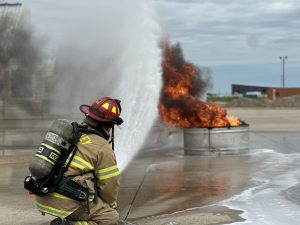
KEARNEY, Neb. — A soy-based firefighting foam is providing a safer alternative to traditional products while creating another market for U.S. soybean growers.
SoyFoam TF-1122 is produced by Cross Plains Solutions using soy meal from the soybean crushing process. It is formulated without intentionally added PFAS, also known as “forever chemicals.” The foam is designed to work with standard firefighting equipment and can be used on both Class A fires, such as wood and paper, and Class B fires involving fuels and oils.
For soybean farmers, products like SoyFoam represent an opportunity to expand demand beyond traditional food and feed uses.
“New uses are very important for the soybean farmer because of the checkoff that they pay,” said Greg Greving, a member of the United Soybean Board and a corn and soybean farmer from Chapman, Nebraska. “We’re always looking for something to move the pile because we have a big pile of soybeans.”
Through soybean checkoff investments, U.S. soybean farmers have helped support extensive testing of SoyFoam’s environmental and performance benefits.
Traditional firefighting foams often contain per- and polyfluoroalkyl substances, or PFAS, a group of chemicals that do not readily break down in the environment. Exposure to PFAS has been linked to several adverse health effects, including certain cancers, reproductive risks and changes in cholesterol levels.
According to research from the Centers for Disease Control and Prevention and the National Institute for Occupational Safety and Health, firefighters face a 14% higher risk of dying from cancer than the general U.S. population.
Greving, who served as a volunteer firefighter for 25 years, said replacing PFAS-containing foams could improve firefighter safety and reduce environmental concerns.
“The foam that’s being used right now has a chemical in it called PFAS, or forever chemicals. It’s very dangerous to firefighters that use it and even people that come in contact with it afterward,” Greving said. “This foam is very safe for the firefighters and very safe for the environment because it’s biodegradable.”
SoyFoam is readily biodegradable by OECD standards, is 84% biobased under the U.S. Department of Agriculture’s BioPreferred certification and has earned GreenScreen Certified Gold status, the first firefighting foam to receive the designation.
Greving said innovations like SoyFoam demonstrate the value of soybean checkoff investments and the versatility of soybeans as a renewable resource.
“It’s just one thing that the farmers can see where their money is going,” he said. “This is a very visible thing.