


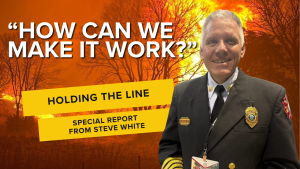
Volunteer fire departments have long depended on neighbors willing to step up when the pager sounds. But as Nebraska communities recover from historic wildfires, many chiefs say their biggest challenge is not only fire danger — it is finding enough people to respond.
This is the second story in a weeklong series, Holding the Line, examining volunteer firefighting in the wake of major wildfires in Nebraska.
“We’ve seen that pool drop quite a bit over the years,” Grand Island Fire Chief Cory Schmidt said. “I think there’s just, there’s a lack of desire to serve the public compared to what that was 10, 20, 30 years ago.”
The shrinking pool of volunteers is forcing departments to take a closer look at the fine print. Some are asking whether bylaws and age limits are too restrictive, and whether they can recruit people who work in town even if they live elsewhere.
Tim Nicholson of Curtis said his department revisited one of those barriers after realizing its age limit did not fit a community that benefits from hundreds of students at the Nebraska College of Technical Agriculture.
“We actually were revisiting our bylaws and constitution because we restricted to 21,” Nicholson said. “We actually went through to get more members, lowered it to 18 because we have the college and we had some ranch kids that had experience with burn groups … but they weren’t old enough, so they couldn’t join.”
Nicholson said this year’s fires also moved some people from considering service to joining.
“Since we had the Cottonwood, the ones that were on the fence on wanting to be involved, we gained seven members out of it,” Nicholson said.
In Alliance, Fire Chief Troy Shoemaker said the conversation extends beyond age requirements. His department already has widened its recruitment area and may need to think even more creatively.
“If you live within the city of Alliance or you live within the Alliance Rural Fire Protection District, you can become a member of the fire department,” Shoemaker said. “So we’ve opened that distance up a little bit.”
Shoemaker said departments also may need to consider people who commute into a community for work.
“We do have people that live in other communities that can be in Alliance for work, and if they’re in Alliance, how can we capture them to be a member?” he said. “Whether they’re at work, how can we structure that and how can we make that work?”
Firefighters say adapting does not necessarily mean lowering standards. Philip Schroeder of Miller said expectations have increased in some cases as departments respond to more complex emergencies.
“The way the world is always changing, we’re always evolving,” Schroeder said. “And somebody said, if you don’t evolve, you’re dying. And so we try to modernize … and we don’t necessarily take requirements away far as training and learning everything. In fact, with our department, we’ve actually increased the responsibilities or requirements.”
Eric Moul with the Nebraska Forest Service said recruitment and retention pressures are not unique to one Nebraska department.
“The recruitment and retention is hard for a lot of volunteer departments across the nation,” Moul said.
Still, firefighters said the reason to serve remains straightforward: If no one steps up, the service disappears.
“The one thing they still have is a fire department that has your town’s name on it,” Bill Grossnicklaus of Oxford said. “And, you know, those guys and gals are all doing their best for you. If you can give them some time, you know, it’s the least you can do.”
For those still hesitating, Cozad Assistant Chief Trevor Munster offered a simple nudge.
“If you’ve thought about it, do it,” Munster said. “Don’t wait till the timing is right, because the timing is never going to be right.”
As departments search for new members, they also are adapting to bigger and more complicated wildfires — emergencies where leadership and coordination can make the difference between order and chaos. The next story in the Holding the Line series will look at how departments manage those challenges.