


In modern poultry production, the scale is hard to ignore. Barns now stretch as large as 70 by 700 feet and can house up to 50,000 birds at a time. While the industry continues growing to meet rising consumer demand, many of the day-to-day tasks inside those barns still rely heavily on manual labor.
That challenge became the foundation for Birds Eye Robotics, a Nebraska startup focused on bringing automation and precision technology into poultry barns.
On this episode of Building Nebraska, Dusty Reynolds explained that poultry production has a major imbalance between supply and demand—while labor shortages continue making expansion more difficult.
“There’s a big gap between poultry consumption in the U.S. and poultry production. We have to grow more protein.”
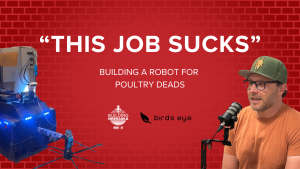
Birdseye Robotics originally started by solving one specific problem: removing dead birds from barns, a physically demanding and unpleasant task growers rarely enjoy.
The company’s first prototype was far from polished.
Dusty says the team bought an old electric wheelchair off Craigslist, modified it, and turned it into an early robot to test whether automation could handle the job.
The robot didn’t just remove mortality—it changed bird behavior.
As the robot slowly moved through the barn, birds would stand up, move aside, drink water, and eat feed before settling back down. That movement created measurable improvements in bird performance.
“A well-hydrated bird is a hungry bird.”
Instead of focusing solely on labor savings, Birds Eye began seeing a much larger opportunity: improving feed conversion and bird health. Since feed accounts for roughly 65% of production costs, even small efficiency gains matter.
The company now sees its future in precision agriculture for poultry—collecting barn-level data to help growers better understand health, environment, and performance.
From litter moisture to gut health to environmental conditions, Dusty believes better data will help poultry producers raise healthier birds more efficiently.
Birdseye’s growth story is also deeply tied to Nebraska.
Even though states like Arkansas and Georgia dominate poultry production, Dusty believes Nebraska is becoming one of the most important regions for future expansion because of its access to feed and strong agricultural workforce.
“Nebraska is full of extraordinary folks that just get crap done… there’s no better place to build a company.”
As poultry production expands across the Midwest, Birdseye Robotics is betting Nebraska can become a hub for the next generation of agricultural innovation.
And if Dusty is right, the future of poultry may not just involve farmers and barns—it may include robotics moving quietly between thousands of birds, collecting data and helping producers make smarter decisions every day.
Sponsored by the University of Nebraska–Lincoln & the Engler Agribusiness Entrepreneurship Program University of Nebraska–Lincoln