

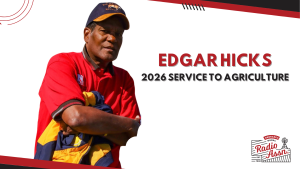
Some people leave a mark on agriculture through a title, a career, or a list of accomplishments. Edgar Hicks did all of that but the people who knew him best say his greatest gift was something more lasting: he connected people.
Rancher Kevin Cooksley and Edgar may have come from different backgrounds but found common ground in their love of agriculture and passion to serve others.
“The first thing that impressed me about Edgar was he seemed to be right at home no matter what kind of crowd he was in, no matter what their color was, no matter what their background was. He just seemed to be able to talk to people from all walks of life with a little ease,” said Cooksley, a Custer County rancher.
Now, as the Nebraska Rural Radio Association honors Edgar Hicks with our Service to Agriculture Award, it’s an opportunity to reflect on how he served, and how his legacy continues in the people and communities he helped move forward.
Born in Louisiana in 1947, Edgar Hicks came of age in the segregated South. His life journey would take him from Louisiana to New York City, from the Chicago Board of Trade to rural Nebraska.
It’s a uniquely American story, a rural America story as Ben Steffen reflects on his late friend.
“The arc of his life really was quite interesting, from growing up in the segregated South to a college education and Pace University in New York City, and then moving into the professional world of commodity trading and working in multiple locations, handling large accounts, and serving agriculture in a very technical career and occupation,” he said.
That career gave Edgar a deep understanding of markets and risk, topics he could discuss as comfortably with Warren Buffett or a beginning farmer. But what set him apart was the way he used that knowledge to serve producers directly.
Steffen said, “He continually worked to try to help educate farmers and producers around the idea of using the futures market as a risk management tool. He was totally aware that farmers were unfamiliar with those techniques and tools, so he reached out repeatedly to try to help people learn and build their understanding of how those things worked.”
Edgar believed agriculture worked best when people had strong relationships and a sense of shared purpose. That belief made him a natural advocate for the Nebraska Rural Radio Association. He saw Rural Radio as more than a source of markets and news. To him, it was a bridge connecting producers, communities, and the future of agriculture itself.
“He thought deeply about the future of the Rural Radio Association, and he thought about the necessity to bring in new members and the next generation of people to support, nurture and lead this company going forward,” Steffen said. “He thought anyone entering the field of agriculture should be listening to the Rural Radio Network. He believed with all his heart that the things that this network and this company does is absolutely the future of agriculture and a connection to all the possibilities.”
Kevin Cooksley first met Edgar and his Anna through the State Grange in the late ‘90s. Their friendship grew through years of conversations, meetings, and shared work around rural communities, food security, and agricultural understanding.
“Whether it was Grange or Farm Bureau or Farmers Union or cattlemen or the crop growers or FFA or vo-ag, he was able to talk to anybody and everybody. And the one common theme in all of it was about how do we feed America and our food security,” Cooksley said.
For Edgar, service to agriculture meant building bridges among people who might not otherwise meet, and helping them see the common ground under their feet.
Edgar’s influence reached far beyond any one organization.
In Nebraska, Kansas, and elsewhere, he invested in the people he believed agriculture needed most: young people, underserved communities, and farmers working to build something lasting for the next generation.
Dr. JohnElla Holmes was fortunate to learn from him.
“What I found out was that he’s absolutely brilliant. He was absolutely brilliant. His networking and everything was just absolutely wonderful,” Holmes said.
Dr. Holmes says Edgar helped lay the groundwork for the Kansas Black Farmers Association. His efforts helped shape the mission, connecting farmers to research, programs, and grants that could help them move forward.
“He was hands on and boots on the ground,” she recalled. “He helped us to see the bigger picture. We were just focused on the here and now. He made sure that when you went in to ask for something, you knew what you were talking about and you had a plan.”
Long before terms like regenerative agriculture and climate-smart practices became common, Edgar was encouraging farmers to think about sustainability, diversification, education, and community connection. He wanted agriculture to remain a pathway to dignity, independence, and possibility.
For all of his professional accomplishments, the people closest to Edgar return to the same truth: he made people feel seen. He may have been the most interesting person in the room yet considered others better than himself.
“One of my favorite mental pictures of Edgar is a picture that I actually have. It’s Edgar volunteering to read to elementary kids in his community in Omaha. He would add voices and actions and all kinds of things, and he’d have the entire group giggling and laughing,” Steffen said.
Kevin Cooksley remembers Edgar as a man with endless ideas, endless curiosity, and a sense of humor that could turn a simple friendship into a story worth telling. One of Kevin’s favorites involved a sport coat he brought home from serving overseas, with his name stitched inside. When Edgar admired it, it found a home in his closet.
“A couple of years goes by and the governor was looking to appoint somebody to the Nebraska Economic Development Commission from Omaha. I called Edgar up and I said, ‘Edgar, you have got the perfect credentials. Throw your hat in the ring for this appointment.’ And lo and behold, he got appointed.”
Cooksley recalled the Broken Bow school superintendent served on the same panel.
“The superintendent went over to him and Edgar put his hand out and said, ‘Hi, I’m Kevin Cooksley.’ And he opened up his jacket. There was his name. The superintendent looked at me and he looked at that name and he looked at me, and his mouth just fell open. Oh, Edgar got the biggest laugh out of that,” Cooksley said.
Those stories endure because they reveal the fullness of the man: brilliant, funny, generous, curious, and deeply human.
Holmes said, “He adored his family. So proud of his son and daughter and their children and his grandchildren. There’s no Edgar without Anna. Anna was definitely the wind beneath his wings.”
Service to agriculture can take many forms and Edgar Hicks did it all, mentoring young people, working with producers, and building stronger communities.
“I think it’s extremely fitting that he be recognized for service to agriculture, because that’s exactly what he represented. That’s what he did,” Cooksley said. “There’s just been nobody quite like him in my lifetime anyway.”
Friends say Edgar often used a word that’s become less common in modern agriculture: husbandry. To him, it meant stewardship—not just of crops and livestock, but of people.
The Nebraska Rural Radio Association proudly honors Edgar Hicks not only for a life spent in agriculture, but for a life spent lifting others through it.