


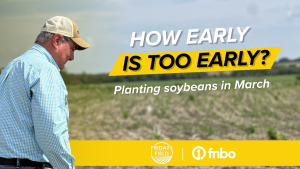
Every spring, farmers weigh the risks and rewards of getting crops planted early. This year, southeast Nebraska farmer Mark Caspers pushed the calendar further than most, planting soybeans on March 26 in hopes of capturing additional yield potential.
The 27-acre trial near Auburn was inspired by the late Jim Specht, a longtime soybean researcher and advocate who encouraged producers to consider earlier planting dates. The concept is straightforward: soybeans planted earlier have more time to develop additional nodes, which can translate into more pod-bearing sites and potentially higher yields.
“Every time they put on a node, that’s where you’re going to get your seed pods come out at. So more nodes is going to equate more seeds, more yield,” Caspers said.
Initially, the experiment appeared to be paying off. Warm temperatures allowed the crop to emerge quickly, and the beans were progressing well through April. By late April, the stand looked healthy and was approaching the V2 to V3 growth stages.
Then came a hard frost on May 3.
The freeze severely damaged much of the early-planted crop, particularly on higher ground, forcing Caspers to replant significant portions of the field. Interestingly, soybeans planted just a few days later escaped major injury because they had not advanced as far in development.
The experience highlighted both the opportunity and the risk that come with pushing planting dates earlier than normal. While earlier planting can increase yield potential, it can also expose young plants to weather events that are difficult to predict.
For many Nebraska farmers, that balance between risk and reward is a familiar part of crop production. Weather remains the biggest variable, especially in southeast Nebraska where most acres rely on rainfall rather than irrigation.
In addition to weather concerns, Caspers is also monitoring disease pressure and emerging insect threats such as soybean gall midge, which has been detected in nearby counties. Those challenges, combined with fluctuating moisture conditions, mean management decisions throughout the season can be just as important as planting date.
Despite the setback, Caspers believes the trial provided valuable information and remains optimistic about the practice’s long-term potential.
“Always got to try something, and I think in the right year it would sure work good. This year wasn’t that year,” he said.
And while the frost may have ended this year’s experiment, it likely won’t be the last. Asked whether he plans to plant soybeans that early again, Caspers didn’t hesitate.
“Absolutely.”