


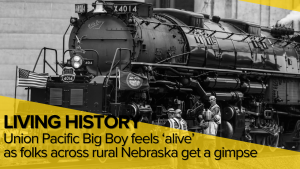
As the nation celebrates its 250th anniversary, a classic piece of iron rumbles across the heartland.
Trains opened the Plains to commerce and travel just as tractors changed how the land itself was worked so when Union Pacific’s Big Boy 4014 rolled through Nebraska, the crowd wasn’t just here to see history, they were hear to feel it.
Howard Urich saw the train pass through Shelton. He farms a little, plays with antique machinery, and says the appeal is easy to understand.
Joking his hearing is no good, this is one machine he doesn’t miss. “I can hear that thing,” he said with a laugh.
That recognition crossed generations along the tracks.
Nathaniel Klein, who farms near Shelton and Cairo, watched with his dad Kristen.
“That was a very good show,” Nathaniel said.
They stood with hundreds of others as the locomotive thundered past.
Kristen said, “I thought it was awesome. I love hearing the sound of it. It was pretty cool. Shakes you pretty good.”
Union Pacific Heritage Operations manager Ed Dickens says steam locomotives still capture people because they engage every sense.
“To see a steam locomotive in operation, feeling the heat off of it, the sensation that the mechanism is alive,” Dickens said. “The locomotive, it lives. The whistle is its voice.”
Unlike a modern diesel, Big Boy depends on constant work from its crew.
“All of the systems are controlled manually by human hands,” Dickens said.
Even operating the whistle takes strength.
“A whistle requires a significant pull. The throttle, all of that requires strength. It’s a very tactile experience from a different era,” Dickens said.
And maybe that’s why the locomotive resonates so deeply. In farm country, machinery is more than machinery. People understand horsepower, steel, maintenance, and what it means to work a machine instead of simply pushing a button and there’s an understanding that distance is measured by hours and acres instead of miles.
Dickens said, “There’s something unique about the Midwest where people appreciate tractors and equipment, just the agricultural nature of what this part of the country does. There’s a lot of people that really appreciate this big mechanism.”
The connection between railroads and agriculture runs deep across the Plains. Railroads helped build towns, move grain, and connect rural communities to markets. In fact, Union Pacific reports it has moved a record volume of grain to start the year, very much still part of the infrastructure of agriculture.
In an era dominated by screens and algorithms, people still gathered beside the tracks to watch steel, fire, steam, and motion.
Some like Howard came to remember.
“I like them all. Anything that’s old. I guess that’s why I like me too,” Urich said with a chuckle.
Others came to experience it for the first time.
But for rural Nebraskans, Big Boy is more than a museum piece, it is a reminder of the machines that shaped this landscape, and of the people who still know what it means to work close to steel, power, and the land.