


Recent rains across eastern Nebraska have brought welcome moisture to crops, but they have also created challenges in some fields as water cut through terraces, ditches, and low-lying areas. Even with the heavy rainfall, Nebraska Extension Educator Aaron Nygren says the 2026 crop is off to a strong start overall.
“A lot of people would be in that five to six inch range easily,” Nygren said while speaking during a Fridays in the Field segment at the Eastern Nebraska Research, Extension and Education Center near Mead. “There was definitely some cutting going on. It was crossing ditches and going into crossroads and it was moving.”
Despite the erosion concerns, Nygren said many corn and soybean stands look good thanks to favorable planting conditions earlier this spring. He noted there could still be some issues in fields where herbicides or nitrogen sat on dry soil for an extended period before the recent rains incorporated them.
“It’s always nice when you can plant in good conditions versus trying to mud it in and just fighting that all year,” he said.
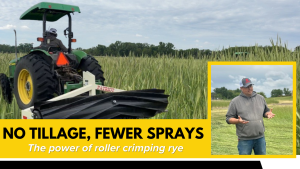
The conversation also focused heavily on roller crimping cover crops, a practice Nygren has used on his own farm since 2010. During the field day, producers gathered to learn how roller crimpers are used to terminate rye cover crops by flattening and crimping the stems, creating a thick mat of residue across the soil surface.
Nygren said one of the biggest benefits of the system is weed suppression. The residue layer helps prevent weeds like waterhemp from emerging while also reducing soil disturbance.
“The nice thing with that roller crimping system is just the weed control,” Nygren said. “Using rye and then crimping it down, it just creates such a mat of residue that really helps out.”
He has seen particular success using the practice in pumpkins, where herbicide options can be limited. The residue also improves field trafficability after heavy rains.
“You’ve got this mat of residue that you can walk on the entire summer,” he said. “We were driving the tractor out here this morning after all the rain we had.”
Nygren said successful roller crimping starts with establishing a thick stand of rye in the fall and waiting until the crop reaches the proper stage in the spring. Growers often seed more than 100 pounds of rye per acre to ensure enough biomass for effective weed suppression. Timing is also critical, as rye generally needs to begin pollination before crimping will consistently terminate the crop.
“So what we want to have is at least two crimps on a plant,” Nygren said. “If we do that, we should have a pretty good chance of killing that plant and not needing a herbicide to terminate it.”
Nygren said the system has applications in both conventional and organic farming. Some conventional growers are experimenting with replacing portions of their pre-emerge herbicide programs with rye residue, while organic producers are using roller crimping as a way to reduce tillage passes and improve soil health.
Fridays in the Field is brought to you by FNB — The Great Big Small Bank.