


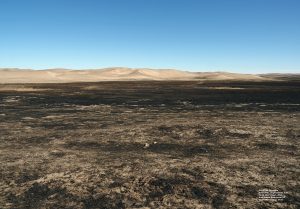
Months after the Morrill Fire burned about 79,000 acres of Blue Creek Ranch near Oshkosh, its effects are still shaping decisions about feeding bison, rebuilding fences and allowing grasslands to recover.
For an operation built around year-round grazing, the loss of nearly all its grazing ground has required changes that extend into winter.
Tyrell Anderson, deputy director of land operations at Turner Enterprises, told the Rural Radio Network that the ranch normally carries 2,500 to 3,000 bison without supplemental feeding. This year, managers bought hay, weaned calves earlier than usual and reduced the herd.
Anderson expected the ranch would need to feed hay again through winter, adding an expense as drought continued and hay prices climbed.
Those challenges followed a three-day firefight in March, when shifting winds pushed flames across the ranch, part of Ted Turner’s ranching operation.
“I mean, as far as the eye can see, it’s black and it’s just you’re in an ocean of burnt land,” Anderson said of the aftermath.
Unlike neighboring cattle producers who found pasture elsewhere, the ranch had limited options for relocating bison. The animals needed suitable fencing and facilities, leaving managers to find ways to keep them on the property.
The ranch held bison on unburned pasture and fed hay for three months. June rain eventually brought enough grass growth to resume grazing, but managers had to move animals through pastures while giving recovering areas time to rest.
Now, Anderson sees encouraging signs in the grasslands, although recovery remains incomplete. He said healthy root systems helped hold soil after the fire and supported regrowth when rain arrived. He estimated another year or two would be needed to return to previous conditions.
Fence rebuilding is another continuing task. Portions of the ranch’s roughly 250 miles of internal and perimeter fencing sustained damage, and Anderson said uncertainty remains about how heat-damaged wire and fiberglass posts will hold up.
The work has also created an opportunity to cooperate with neighbors. Along some boundaries, separate cattle and bison fences can be replaced with a shared five-wire barbed-wire fence that neighboring ranchers know how to maintain.
As recovery continues, Anderson said the ranch is also examining gaps the fire exposed in emergency communications and equipment.
The experience reinforced the importance of neighbors, including those who kept fighting after their own ranches burned and people who sent hay from miles away.
“We can overcome big things,” Anderson said. “We can work together to solve problems, and we can work together to plan for the future, to prevent some of these things or to be better prepared when they do happen.”
Listen below to the full conversation with Anderson about the firefight, ranch recovery and lessons learned.