

A sandwich filled with ground beef and cabbage might not sound like an obvious recipe for a regional restaurant chain. But in Nebraska, the Runza sandwich has become part of the state’s identity, with loyal customers, Husker game-day traditions and a business that has grown to 93 restaurants.
Donald Everett Jr., president of Runza, joined the Building Nebraska podcast to explain how a German-Russian family recipe became one of Nebraska’s most recognizable food traditions and why the sandwich continues to shape the company’s business decisions.
“The Runza sandwich is both an asset and a liability for us,” Everett said.
He said the sandwich is not for everyone, particularly outside Nebraska, where customers may be less familiar with cabbage as a main ingredient. While the company is proud of the loyalty Nebraskans have built around the sandwich, that same identity can make expansion into new markets more challenging.
“Nebraskans embrace Runza restaurants and the Runza sandwich as their own,” Everett said. “We’re super proud of that and we never want to lose that loyalty.”
The sandwich traces its roots to the German-Russian community, where similar stuffed breads were known as bierocks. Everett said his grandmother, who opened the first Runza restaurant in Lincoln in 1949, gave the sandwich its name and adapted the recipe by increasing the amount of ground beef.
What started as a family restaurant eventually became a regional business. Today, Runza operates 93 locations, including restaurants in Colorado, Kansas, Iowa and South Dakota. Everett said the company sees opportunities to continue expanding, particularly in smaller markets close to its existing locations.
Runza currently operates in Nebraska communities with populations as small as 1,500. Everett said those restaurants depend heavily on the people who own and operate them.
“We don’t open franchises without owner operators,” Everett said. “It’s their business, it’s their livelihood. They’re in there on the regular.”
The company also has a different approach to ownership within its company-operated restaurants. Runza owns 50 of its 93 locations, and many managing partners have at least 20% equity ownership, giving them a financial stake in the business.
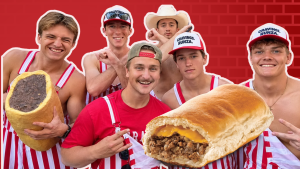
Behind the familiar sandwich is also a daily production process. Everett said every Runza location makes its dough from scratch each morning, using ingredients such as flour, water and shortening. Employees then wrap the filling by hand.
That process becomes especially important during busy promotions and Husker football weekends. On peak game days, Runza can sell 15,000 to 16,000 sandwiches inside Memorial Stadium. Restaurants across Lincoln prepare the sandwiches ahead of time, while corporate employees and restaurant staff help bake, wrap and distribute them.
The company’s January Temperature Tuesdays promotion also brings corporate employees into restaurant operations. Everett said he can be found at the production table hand-pinching sandwiches alongside other employees.
For Everett, maintaining that connection between the product, employees and customers is part of what has kept the business growing. He credits his grandmother and father with passing down an entrepreneurial mindset that encourages trying new things rather than being afraid of failure.
“Don’t be afraid to fail and continue that serial entrepreneurship spirit,” Everett said.
As Runza looks toward future growth, the company plans to build on its regional presence while protecting the Nebraska connection that helped make the sandwich a staple in the first place.
The sandwich may not be for everyone, but in Nebraska, that has never stopped people from making it their own.
Building Nebraska is produced by the Rural Radio Network in partnership with the Engler Agribusiness Entrepreneurship Program at the University of Nebraska–Lincoln.