


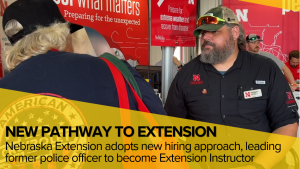
Nebraska Extension says a new hiring program could be the difference between having a local educator and leaving a county without one.
The Extension Instructor program was created after Nebraska Extension encountered increasing difficulty recruiting candidates for county-based positions, according to Dave Varner, associate dean and associate director of Nebraska Extension.
“A couple of years ago, we noticed that we were having more of a challenge recruiting talent, bringing talent into the Extension roles,” Varner said. “At that time, we were requiring master’s degrees to land those positions. And so we started this Extension Instructor program.”
The program allows candidates with a bachelor’s degree to begin working in Extension while completing a master’s degree within five years. Participants receive tuition reimbursement through the University of Nebraska system as they pursue their degrees.
Varner said the program has helped Extension fill positions that may otherwise have remained vacant.
“It’s been wildly successful,” Varner said. “In the last couple of years, we’ve hired over 20 Extension Instructors who are actively working as Extension Educators somewhere in Nebraska.”
Without the program, Nebraska could have as many as 20 counties without Extension Educators, he said.
“We don’t like to see those gaps, right? Keep those relationships, those partnerships, that trusted network in force all the time,” Varner said.
A new career in public service
For Chris Termunde, an Extension Instructor in water and cropping systems based in Phelps County, the position represents a continuation of a career focused on serving the public.
Termunde spent 10 years as a police officer in Georgia before coming to Nebraska to pursue a master’s degree. His path into Extension developed after he began working with Extension personnel.
“When I first came up here for my master’s degree, it wasn’t in the cards,” Termunde said. “But then working with Tamra Jackson-Ziems and helping her out with Extension, I saw it as a way of continuing my service to the community that I’ve been doing for 10 years prior to this. Just in a completely different capacity.”
Termunde said the opportunity to earn a graduate degree while working makes the transition more accessible. Termunde, who was working on his thesis at the time of the interview, said the arrangement significantly reduces the cost of his education.
“All I have to do is pay for student fees, which is significantly less than the total tuition,” he said.
Although his professional focus has changed, Termunde said the underlying purpose of his work remains the same.
“I’ve always liked serving the community and trying to make it a better place for people to live,” he said.
Extending the reach of university research
The Extension Instructor program is not limited to agricultural positions. Varner said it applies across Nebraska Extension’s program areas, including 4-H youth development, early childhood education, health and nutrition, agriculture, and community development.
Extension personnel work to translate university research into practical information and skills that people can use in their daily lives and professions.
Termunde said that mission was familiar to him even before he joined the university.
“Growing up, I’ve always known what land-grant universities were here to give: education to the farmer and the public for free, to give them what we learn and research every day that the university is conducting, and translating that into real-life technology and skills for the public,” he said.
Varner said the program can attract people at different stages of their careers, including recent graduates and people transitioning from other professions.
The program also provides flexibility in choosing a graduate degree focus, as long as it relates to the employee’s Extension role.
“If you love lifelong learning, there’s no better occupation than to be an Extension and be part of your university and a part of your community,” Varner said.
He encouraged people interested in Extension careers to contact the university about the program.
“We open the door wider to invite more talent, more Nebraskans, more individuals, you know, anywhere across the nation to be a part of this great Extension network,” Varner said.