


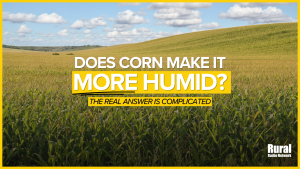
Every August, as cornfields turn Nebraska into what can feel like one giant green greenhouse, the same question tends to come up:
Is all that corn actually making it more humid?
The short answer: yes, but probably not as much as you think.
Nebraska Extension meteorologist Dr. Eric Hunt says corn and irrigation add moisture to the atmosphere through evapotranspiration, the process by which plants move water into the air. That can push Nebraska’s dew points higher, particularly during the heart of summer.
But the idea that Nebraska would be almost semi-arid without its cornfields doesn’t hold up.
“Now, would we have dew points that were pushing upper 70s to 80 degrees at times? No. We do get that because of the extra evapotranspiration from the corn.”
Irrigation adds to that effect, too. Water applied to fields eventually finds its way back into the atmosphere, contributing additional moisture.
Still, Hunt says there’s another factor that is much bigger than the corn itself: the atmosphere is warmer and capable of holding more moisture than it was decades ago.
“But another factor that we have to really consider, the oceans are warmer than they were 40 years ago. Planet’s warming.”
Hunt says that warmer background climate matters because Nebraska gets much of its summer moisture from the south. As temperatures rise, the air moving north can carry more water vapor with it.
And Hunt says the increase in humidity isn’t unique to farm country.
“Frankly, just we are getting higher dew points across pretty much everywhere east of the Rockies than we used to.”
So, yes, Nebraska’s massive corn crop and irrigated acres are part of the humidity equation. But they’re not creating Nebraska’s muggy summers from scratch.
And there’s an agricultural wrinkle to all that nighttime moisture.
Hunt says Nebraska has experienced a lot of warm nights this summer, and that can be a bigger concern for corn than a hot afternoon alone.
Corn benefits from a large diurnal temperature range – warm days followed by cooler nights. When nighttime temperatures remain in the upper 60s or 70s, the plant gets less of a break.
“We really do kind of want that 20 to 25 degree diurnal range. And these warm nights, even if we aren’t necessarily that warm during the day, we are still consistently in the upper 60s, 70s at night. That does tend to take down the yield.”
For Nebraska producers, that means the weather story heading into the latter part of the growing season isn’t simply about how hot the thermometer gets.
It’s about how warm the nights stay, how much moisture arrives and how much water the crop can actually use.
And there’s potentially another twist coming.
Hunt says global models are pointing toward a wetter-than-average fall, which could provide much-needed recharge after years of drought, but it could also create headaches at harvest.
A wet fall would be welcome news for depleted soil profiles and drought-stricken areas of Nebraska. But too much moisture could make getting the crop out of the field difficult.
In other words, after years of worrying about whether Nebraska would get enough rain, producers could eventually find themselves worrying about whether they can get too much.
That’s a very different problem, but for Nebraska agriculture, it could be a welcome one.