


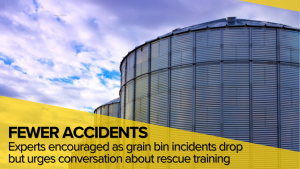
Purdue University’s latest report on farm safety offers some encouraging signs: fewer documented cases, fewer grain entrapments and what safety specialist Bill Field says appears to be greater awareness across farm country.
But Field, an extension safety specialist at Purdue and a professor in the Department of Agricultural and Biological Engineering, said there is no substitute for preventing the emergency in the first place.
“We have almost forgotten the problem is one that we need to address as prevention,” Field said. “We’ve got to remember that building an ambulance station next to every farm is not the answer. We’ve got to try to focus on what’s causing this to continually happen.”
The 2025 Summary of U.S. Agricultural Confined Space-related Injuries and Fatalities documented at least 48 cases, including 22 fatal and 26 nonfatal cases. That was down 5.9% from 51 cases in 2024 and well below the 10-year average of about 60.
The report also documented at least 21 grain-related entrapments, a 38% drop from 2024. Purdue said 46% of all documented confined space cases in 2025 were fatal, below the historical fatality share of 58%. Among grain entrapments, 28.6% were fatal.
Field said the lower numbers may reflect years of work on grain quality, bin safety standards, signage and training.
“We sort of reached a lower plateau,” Field said. “There was a lot of effort invested into trying to reduce this problem from occurring — everything from improving grain quality so farmers don’t have to get in bins to new grain bin safety standards to new signage. And I think it’s all having an impact.”
Even so, he said, the danger remains. “Every year we still have 20, 30 of these incidents occurring, and about 60% of them die as a result of suffocation,” Field said.
Field said one challenge is that farm incidents are difficult to track. Many farms are not covered by the same reporting requirements as other workplaces, and no central repository captures every case. Purdue relies on media reports, OSHA and labor records, state fatality reports, word of mouth and, increasingly, obituaries.
“There is no monitoring. There’s no central depository,” Field said. “We estimate, based on historical records and the work we’ve done here in Indiana and Illinois, that we miss about 30% of the cases, because they’re just not reported, including fatalities.”
The report found Minnesota had the most documented confined space-related cases in 2025, with eight, followed by Colorado with seven and Indiana with six. Indiana and Minnesota each had five grain-entrapment cases, followed by Illinois with three.
Field said grain entrapments often begin when stored grain goes out of condition and farmers enter bins to break up crusted or spoiled grain or clear a plugged auger system. He said too many victims are working alone.
“It’s still, let’s try to refocus our attention on making sure that no farmer goes into a grain bin by himself,” Field said. “So many of these are just people working all alone.”
He said rescue training and equipment have a place, but should be a secondary consideration after prevention. Field has trained thousands of responders and said Purdue helped develop the first commercially available grain rescue tube. Still, he said the national conversation has at times focused too heavily on rescue after an incident has already become life-threatening.
“We have distributed thousands of grain rescue tubes all over the United States, including in the counties where there are no grain bins,” Field said. “I’m just saying, we’ve got a little intoxicated with it.”
The Purdue report also highlighted risks beyond grain bins. Four incidents involved livestock waste storage pits or lagoons, resulting in 10 fatalities, including six deaths in one incident. Vertical or tower forage silo incidents accounted for three fatalities and three nonfatal cases.
Field said manure storage deserves more attention, especially as modern livestock operations rely on skid steer loaders to scrape alleys and push manure into pits or lagoons.
“If you go off an edge and drop 10 feet into a manure pit, there’s no way you’re going to get out,” Field said. “Almost every one of these cases was a fatality.”
Those sites can also produce secondary victims when family members, workers or bystanders rush in to help without proper breathing equipment or training. Field pointed to incidents in which multiple people died after trying to rescue an initial victim.
“We admire” that impulse, Field said, but “it ends up in the loss of additional life just because they don’t know how to respond properly to these circumstances.”