


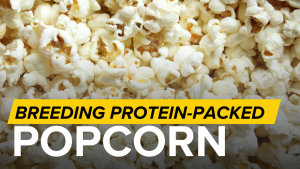
Popcorn has long been promoted as a healthy snack, but researchers at the University of Nebraska–Lincoln believe it can be even better.
Dr. David Holding, a professor of agronomy and horticulture at UNL, is applying decades of research on Quality Protein Maize to develop popcorn with improved nutrition, enhanced flavor and the popping characteristics consumers expect.
Unlike traditional popcorn, the new varieties contain higher levels of the essential amino acids lysine and tryptophan, nutrients that are naturally limited in conventional corn.
Holding said the goal is not to replace traditional popcorn but to create new opportunities in the healthy snack market.
“Our rationale to do this was to enhance the protein quality of popcorn,” Holding said. “The expectation was that the final product would open up new niche markets within the healthy snack food market.”
Because popcorn is sold by volume rather than weight, breeders have historically prioritized large, fluffy kernels that maximize expansion during popping. Holding said that focus has often come at the expense of flavor and texture.
“This maximization of flake volume has really led to neglect of the inherent taste and texture of the popcorn itself,” he said.
Consumer taste panels found the experimental popcorn varieties outperformed conventional popcorn even when prepared without butter, oil or salt, suggesting the kernels have stronger natural flavor and texture.
Researchers have also found the new popcorn lines exhibit enhanced prebiotic properties, which may help support beneficial gut microbes.
The project builds on earlier research using proprietary popcorn genetics. Holding’s team is now developing publicly available quality protein popcorn varieties, including colored popcorn, that could be grown by smaller companies and organic producers.
Holding said the work demonstrates how long-standing corn breeding research can create new value in familiar foods.
If commercialized, quality protein popcorn could offer consumers a snack with improved nutrition and flavor while providing growers and specialty food companies with a new niche market.