


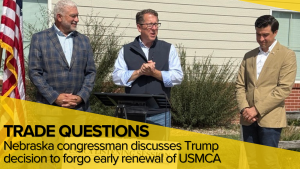
Nebraska Rep. Adrian Smith said the U.S.-Mexico-Canada Agreement remains fully in force despite the Trump administration’s decision not to renew the trade agreement ahead of this week’s review deadline.
The Trump administration announced Wednesday it would not agree to an early 16-year extension of the agreement, instead allowing USMCA to enter a new phase of annual reviews while negotiations continue with Canada and Mexico.
Smith, a member of the House Ways and Means Committee, said the move should not be interpreted as ending the agreement.
“It needs to be very clear that today is not a termination,” Smith said in an interview with the Rural Radio Network. “It’s a new phase, if you will, that I think puts more pressure on negotiators to say, ‘Hey, let’s do what we need to do to get this deal wrapped up.’”
Under the agreement negotiated during President Donald Trump’s first term, the three countries could have jointly agreed by July 1 to extend USMCA for another 16 years. Instead, the agreement will remain in effect while the three countries conduct annual reviews through its scheduled expiration date in 2036.
Smith said the trade agreement has benefited Nebraska agriculture.
“USMCA has been good. It’s been productive for American agriculture and, more specifically, Nebraska agriculture,” he said. “The U.S. and Canada account for about $1.6 billion of agriculture sales and exports for Nebraska.”
He said the administration’s decision reflects a desire to strengthen enforcement rather than abandon the agreement.
Smith pointed to disputes with Mexico over grain inspections and biotechnology corn, along with Canada’s dairy policies, as examples of issues he believes should be addressed.
“We’re finding out that Canadian government … agreed to some new policies that they immediately found a way around,” Smith said. “That’s unfortunate because that undermines the entire agreement. But now is the opportunity to fix those things moving forward.”
Although Trump negotiated USMCA as a replacement for the North American Free Trade Agreement during his first administration, Smith said experience has exposed areas where enforcement can be improved.
“What we’ve learned over time is that trade agreements can’t cover everything,” Smith said. “We’re seeing that enforcement on these issues that I’ve mentioned has been lacking.”
Smith said he believes the review process presents an opportunity to strengthen the agreement rather than weaken it.
“There’s a great opportunity for a stronger USMCA that delivers even better results than what we’ve seen,” he said. “The easy solve is for our trading partners of Canada and Mexico to step up on that enforcement and really ensure that enforcement can level the playing field.”
Smith also noted Congress will continue to play a role if substantive changes are made.
“Changes to how we do things with USMCA would need a vote of Congress,” he said. However, he said stronger enforcement actions by Canada or Mexico would not necessarily require congressional approval because they would involve changes by those governments rather than U.S. law.
If Canada comes to the table, Smith says the countries could work together to resolve their issues and find a path forward.