


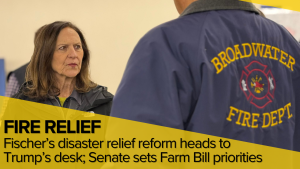
A wildfire disaster relief bill led by U.S. Sen. Deb Fischer is headed to the president’s desk, a move she says should help Nebraska farmers and ranchers get federal recovery assistance sooner after a devastating spring fire season.
The Emergency Conservation Program Improvement Act cleared the House after passing the Senate by unanimous consent in March. The bill is designed to expedite access to assistance through the U.S. Department of Agriculture’s Emergency Conservation Program and Emergency Forest Restoration Program, which help producers repair and restore land damaged by natural disasters.
In an interview with the Rural Radio Network, Fischer said the push gained urgency after she returned from viewing wildfire damage in Nebraska. She said disaster payments too often “take forever” to reach producers, leaving them to delay repairs or begin rebuilding without knowing whether federal help will arrive.
“When farmers and ranchers have these losses, like they did with these spring fires, they need assistance right away,” Fischer said. “When they qualify and work with these agencies, they can get those payments earlier.”
The measure would allow eligible producers affected by disasters to receive an advance on cost-share assistance based on existing USDA estimates. It also updates wildfire eligibility to include fires caused or spread by natural causes, as well as wildfires caused by the federal government.
Fischer said the bill is aimed at cutting red tape at a time when producers may need to rebuild fences, restore grazing land and make other repairs before they can return property to productive use. She credited Rep. Adrian Smith for helping move the bill through the House.
Fischer also reminded producers that the deadline for Emergency Conservation Program applications at Farm Service Agency offices has been extended to Aug. 25.
Wildfire experience shapes policy push
Fischer said the legislation reflects on-the-ground lessons from disasters in Nebraska and elsewhere. She said many federal programs begin with problems raised by constituents after a disaster, and the recent fires helped sharpen the focus on how quickly assistance can be delivered.
“A lot of things are in the abstract here,” Fischer said of Washington policymaking. She told colleagues Nebraska has seen close to a million acres burned, a scale she said surprised some senators because the fires have received limited national attention.
Farm Bill draft includes Fischer priorities
Fischer also pointed to several Nebraska-focused provisions included in newly released Farm Bill text from the Senate Agriculture Committee. She said the draft shows lawmakers are still working to move a full Farm Bill after operating under an outdated law.
The draft includes Fischer priorities tied to precision agriculture, rural connectivity, disaster recovery and tribal nutrition programs. Among them are the PRECISE Act, which would provide financial tools to help producers adopt precision agriculture technology; the Precision Agriculture Loan Act, which would create USDA loan financing for precision ag equipment; and the LAST ACRE Act, which would expand network connectivity across farmland and ranchland.
The text also includes the Increasing Tribal Input on Nutrition Act, intended to require USDA to incorporate tribal input in contracting decisions and improve emergency response during food supply disruptions. Fischer said she worked with Nebraska tribes on the issue.
Another provision, the FENCE Act, would authorize USDA to include virtual fencing as an option under the Emergency Conservation Program. Fischer co-led the measure with Sen. Pete Ricketts, and said it could give producers more flexibility as they rebuild after disasters.
Fischer said Chairman John Boozman has traveled widely to hear from producers and senators in both parties. She said the draft is meant to jump-start negotiations, but added that a bipartisan process will be needed for a final Farm Bill.
Precision ag and broadband seen as long-term investments
Fischer said precision agriculture is central to the future of farming and ranching because it can help producers improve profitability while strengthening conservation. She cited tools that can measure soil moisture and newer equipment that depends on reliable connectivity.
“It’s the future,” Fischer said. “It’s going to help producers use all that cool new technology that’s out there and become more profitable and also be even better conservationists than they are now.”
She said broadband has to be treated as infrastructure because producers cannot fully use precision agriculture tools without strong rural connectivity. Fischer said improving access could also help rural communities remain viable, grow and attract young people back to agriculture.
“We have to make sure that all of Nebraska is connected and able to innovate into the future,” Fischer said.