


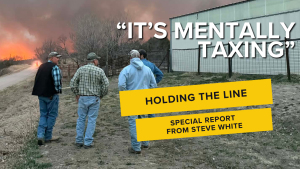
Fighting fire takes a physical toll, but firefighters say the strain does not end when the flames die down.
This is the fourth story in a weeklong series, Holding the Line, examining volunteer firefighting in the wake of major wildfires in Nebraska.
For volunteer firefighters, a pager call can come in the middle of work, dinner or the middle of the night. When the call is over, many return to their jobs the next morning, carrying exhaustion that can build over a long and punishing fire season.
That physical fatigue can blend with something harder to measure: the mental and emotional toll of repeated emergency calls.
“The mental health in the fire service is really a big thing anymore,” Oxford Fire Chief Bill Grossnicklaus said.
Grossnicklaus said that reality became impossible to ignore during major wildfire responses in Nebraska’s historic spring fire season.
“We were seeing some guys that were really showing legitimate signs of PTSD, when we were going out every day on a big fire,” Grossnicklaus said. “And you just have to be willing to every now and then say, hey, I’m going to take a breather here. Maybe sit back on this one and catch my breath.”
He said the work itself can be jarring enough. For volunteers, there is another layer: They are truck drivers, farmers, teachers, mechanics or others who suddenly find themselves facing a wall of fire.
“My firefighters, you know, they go to work all day and then they’re getting up in the middle of the night or leaving work to go to this,” Grossnicklaus said. “And if you’re a truck driver, insurance salesman, whatever you do for a living, that doesn’t really prepare you to go fight a 200-foot tall tower of fire that’s three miles wide.”
Eric Moul with the Nebraska Forest Service said the emotional burden can be even heavier when firefighters know the people affected. Moul, who also serves as a volunteer firefighter, said those ties make the losses personal.
“It was very mentally taxing on a lot of people just because of how many fire districts were involved,” Moul said. “And, you know, when you’re a volunteer, like myself and other people here, you’re invested in those communities and, you know, those people.”
For many firefighters, the losses are not abstract. The ranch, pasture or home threatened by fire may belong to someone they grew up with, see at ballgames or sit near at church.
“The last thing that we want to see is our neighbors’ houses be affected and our neighbors be affected,” Moul said. “So it is very taxing.”
All of it unfolds against a backdrop of family schedules, employers and limited time — the same support system that makes volunteer service possible in the first place.
“It takes a lot of support, not only of their employers and their family members, and the volunteers especially are sacrificing a lot of personal time,” Grand Island Fire Chief Cory Schmidt said.
Schmidt said that support now has to include an understanding that mental health matters, too. Firefighters said stepping back for a breather is not weakness, but part of staying healthy enough to keep serving.
The International Association of Fire Fighters says there’s is growing concern about behavioral health issues in the fire service. Firefighters, EMTs, and paramedics routinely deal with people experiencing trauma — fires, car crashes, accidents, and more.
The IAFF said “the significant impact on wellness. The stresses faced by fire fighters, paramedics and EMTs throughout the course of their careers – “incidents involving children, violence, inherent dangers of firefighting and other potentially traumatic events can have a cumulative impact on mental health and well-being.”
That raises concerns about substance abuse, opioid addiction, suicide, and other mental health issues firefighters may face, volunteer or paid professional. Plus there are physical health concerns, with firefighting linked to cancer.
“The equipment that they have, it’s it keeps them safe, but it’s not safe for them, for their physical well-being because of the chemicals in it,” Sen. Deb Fischer told the Rural Radio Network.
She has introduced legislation addressing so-called forever chemicals found in fire gear.
“That they have the necessary equipment they use that we recognize the cancer that they’re exposed to from that and that we take care of these guys, hese men and women who are out there risking their lives for us,” Fischer said.
As departments try to recruit the next generation, that reality is becoming part of the conversation — not only how to fight the fire, but how to sustain the people who answer the call.
The next story in the Holding the Line series will look at the future of firefighting in Nebraska.