


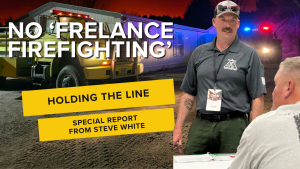
GRAND ISLAND, Neb. — Inside a building better known to many as the 4-H building at the Nebraska State Fair, firefighters were not pulling hoses or advancing toward flames. They were gathered around tables, talking through problems, testing communication and learning how to keep fast-moving wildfire scenes from slipping into chaos.
This is the third story in a weeklong series, Holding the Line, examining volunteer firefighting in the wake of major wildfires in Nebraska.
As Nebraska’s wildfire seasons grow longer and more intense, firefighters say one department alone often cannot handle the job. That has pushed departments to lean more heavily on leadership training, mutual aid and task force responses before crews ever get near smoke or flame.
Leading one class at Fire School was Eric Moul with the Nebraska Forest Service, who said wildfire leadership starts with making sure everyone understands the assignment.
“The biggest thing that we try to convey is with leadership, it all hinges off of task, purpose, and end state,” Moul said. “This is what needs done, this is why it needs done, and this is how it should look at the end.”
Moul said the reason is simple: In a wildfire, confusion can be dangerous.
“The last thing that you want is what we call freelance firefighting, where people are just kind of going wherever, and there’s no real leadership there,” Moul said.
Wildfire brings its own hazards. Unlike a structure fire, crews work in a shifting environment shaped by wind, terrain and whatever is burning.
“There’s three aspects to what influences the fire in the wildland fire environment,” Moul said. “It’s fuels, weather and topography.”
In the class was Trevor Munster, assistant chief in Cozad, one of the firefighters taking part in the training. He said younger members in particular are seeing fires on a scale that would have been hard to imagine a few years ago. His department was among those responding to the Cottonwood Fire, which burned nearly 130,000 acres.
“It’s been a busy year. A lot of mutual aid happening,” Munster said. “Obviously, it’s dry everywhere, so all the departments are working together across the state. It’s been a real eye opener for a lot of younger members. Even the older members, the fires we’ve seen this year are like nothing they’ve seen in the past.”
That reality has led departments such as Oxford to rethink how they respond.
“Individually we don’t respond anymore. We respond as a task force,” Oxford Fire Chief Bill Grossnicklaus said.
Grossnicklaus said one department alone often does not have enough people available, especially during the workday.
“When you got 25 guys, you might only have five that are in town during the day,” he said. “So you got to rely on your neighbors.”
Tim Nicholson of Curtis said those formal relationships with neighboring departments are essential.
“That’s where the mutual aid comes in,” Nicholson said.
Moul said good leadership begins before the first tone goes out. That is part of why classroom exercises matter, he said: They help firefighters learn to work together before they are tired, stressed and staring at a fast-moving fire line.
One exercise did not involve hoses or bunker gear. Instead, firefighters used art supplies in a test of teamwork under pressure.
“Basically we want to help them to set their team up for success instead of failure,” Moul said.
Munster said training increasingly includes technology as departments dig deeper into wildland firefighting.
“Between the technology and the training that’s put forth, the last few years we’ve really dug deep into the wildland fire side of things,” Munster said.
The Nebraska Forest Service says it no longer talks only about fire seasons, but fire years. For volunteer departments, firefighters say, it is no longer enough simply to show up. Wildfire response requires preparation, coordination and leaders ready to lead.
The next story in the Holding the Line series will look at what comes after the flames: the fatigue firefighters carry when the emergency is over.