


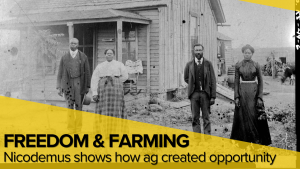
After our nation’s darkest days during the Civil War, some who had been enslaved found freedom in working the land, their own land. Nicodemus, Kansas is the oldest Black settlement west of the Mississippi but it’s more than a history lesson as black farmers continue to farm there today.
When people think about Juneteenth, they often think about the end of slavery. But for the families who settled Nicodemus, freedom was only the beginning of a much longer journey.
Founded in 1877 by formerly enslaved people and their descendants, Nicodemus became a place where Black families could own land, farm for themselves, and build a future on the Great Plains.
Dr. JohnElla Holmes, president and CEO of the Kansas Black Farmers Association, has a personal connection to that history.
“I am a fifth-generation Nicodemian from original settlers,” Holmes said. “My great-great-grandparents were ones that settled and homesteaded in Nicodemus in 1877. Someone from that line has consistently lived and farmed in Nicodemus since 1877.”
While much of the nation’s attention has focused on the migration of African Americans to northern cities following the Civil War, Holmes said there was also a significant westward movement.
“Congress wanted to investigate, to find out why are they moving west,” she said. “Well, it was uncharted territory. There was land still available. You could get a piece and homestead it and be farmers and legitimately feed your family and communities.”
Agriculture quickly became the foundation of life in Nicodemus.
“That’s all of our community out there, and it still exists today,” Holmes said. “In 2026, we’re farmers out there.”
For those seeking a new life, farming provided a chance to create generational opportunity. The settlers arrived from Kentucky, where tobacco was a dominant crop. Farming on the High Plains required new skills. Holmes said Indigenous people helped teach Nicodemus settlers how to grow crops such as wheat, corn and sorghum in Kansas conditions.
The learning curve was steep. Settlers faced droughts, dust storms, harsh winters and limited resources. Like many other homesteaders of the era, they often worked the land with horses or mules because they lacked the money to purchase equipment.
Despite those challenges, Nicodemus endured.
At one point, more than 34,000 acres were designated as Black farm homesteads in the area. Holmes said the opportunity to own land represented something many formerly enslaved families had never experienced.
“It was such a pride to own your own land,” she said. “Build your home and be able to give that to your children.”
That sense of stewardship continues today.
Holmes said her family still owns 40 acres from the original homestead established by her great-great-grandparents nearly 150 years ago.
“I have a lot of pride that we still own just 40 of the original acres,” she said.
For Holmes, the story of Nicodemus also illustrates an important distinction between freedom and opportunity.
Although slavery officially ended in 1865, many newly freed African Americans faced enormous uncertainty about how to support themselves and their families.
“For an African American that only knew that kind of life on a plantation, and then to be told you’re free — how do you get a job? What do wages look like?” Holmes said. “How does my family survive outside of this environment?”
She said education, information and community support were all necessary to help people transition from emancipation to independence.
Today, Nicodemus remains the oldest continuously existing all-Black town west of the Mississippi River and is recognized as a National Historic Site.
Holmes hopes people see it as more than a chapter in a history book.
“The celebration needs to continue because we’re prospering,” she said. “We’re doing the best that we can to keep our farms and to keep them going and to help feed America. That’s what’s important to us.”
As Americans mark Juneteenth, Nicodemus stands as a reminder that the story of freedom did not end with emancipation. On the plains of Kansas, it grew into a story of agriculture, land ownership and generations of families working to build something they could call their own.