


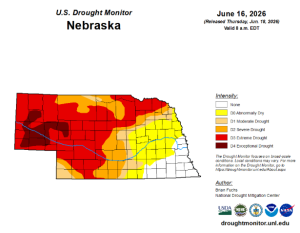
KEARNEY — Recent rainfall helped ease drought concerns in parts of central and eastern Nebraska, including areas near the Tri-Cities, but conditions continue to deteriorate in the Nebraska Panhandle, where agricultural impacts are among the worst seen in decades.
The latest U.S. Drought Monitor update, released June 18, showed that the remaining area of exceptional drought, or D4, in Frontier County has been eliminated.
However, exceptional drought expanded elsewhere in the state. Nebraska’s total D4 coverage increased from 5.9 percent to 7.2 percent, with all of that area now located in the Panhandle.
Areas east of the Tri-Cities saw some improvement after recent rainfall. Moderate drought, or D1, was reduced in that region and downgraded to abnormally dry, or D0, conditions.
Kearney and all of Buffalo County remain in severe drought, or D2. Extreme drought, or D3, continues to cut across portions of Custer, Dawson, and northern Gosper counties.
Overall, about 90 percent of Nebraska remains under some level of drought designation.
In its High Plains summary, the U.S. Drought Monitor noted that drought continues to hold across western Kansas and eastern Colorado, with the most serious conditions stretching from eastern Wyoming into western and northern Nebraska and far southern South Dakota.
The report said exceptional drought expanded across three Panhandle counties, where pasture and dryland wheat conditions are the poorest seen in decades. The worsening conditions follow a record warm and dry winter, along with limited spring rainfall. Drought indicators over the past six to 12 months also confirmed the agricultural impacts in western Nebraska.
The only improvements in the High Plains region were reported in central and eastern Nebraska, where multiple bands of 2 to 4 inches of rain fell over the past week along the Interstate 80 corridor and into southeastern Nebraska. That portion of the state is now free of drought and abnormal dryness, according to the U.S. Drought Monitor.