

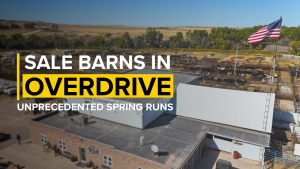
The chant of the auctioneer is getting faster in western Nebraska as drought forces more cattle and more hard decisions into the sale ring.
Drought, liquidation pressure and uncertainty about the future of cattle country are converging in the heart of cattle country, according to Crawford Livestock Market co-owner Alicia Robertson.
Robertson said the volume of cattle moving through the Crawford, Nebraska-based market has surged far beyond normal seasonal levels as producers continue to grapple with dry conditions and difficult long-term decisions.
“We’ve got a feeder sale on Friday, that last year on the same sale, we had 1,800 head and I’ve already surpassed 4,000,” Robertson said. “The parking lot is a swarm of trucks that are unloading on a Wednesday before a Friday. The dust is swirling and it’s just kind of a depressing sight, honestly.”
Robertson said the market remains supported by strong cattle prices for now, but she worries the rapid increase in supply could eventually pressure demand.
“It’s all about supply and demand,” she said. “The more cattle that come into town now, our market gets saturated. There’s only so many places pairs can go.”
Crawford Livestock has seen a sharp increase in all classes of cattle, including weigh-up cows, bred females and cow-calf pairs. Robertson said the market has adjusted its normal summer schedule to hold sales every Friday due to the higher-than-normal numbers.
The liquidation is also stretching far beyond Nebraska’s borders. Robertson said cattle from western Nebraska are being shipped to buyers across the country, including Minnesota, North Dakota, Kentucky, New Mexico and Kansas.
“That’s heartbreaking for us as market owners because all of those pairs that we would get to sell their calf crop, we’re not going to see those animals in our country for a long time, if ever,” she said.
Robertson said the ongoing drought and historically high land values are making it difficult for younger producers to expand or enter the cattle business, especially as development pressure grows in parts of western Nebraska.
“I do foresee the cattle will rebuild,” Robertson said. “But what my fear is, is these small markets in small towns, they’re not going to be able to sustain it. We’re going to see some barns close and some consolidation.”
Robertson said recent herd dispersal sales have carried a mix of financial opportunity and emotional weight for producers and livestock markets alike. While ranchers capitalize on high prices, she acknowledges that for many, raising cattle is all they know.
“I’m always happy when we get a good price for cattle for my customers,” she said. “But when the cattle aren’t coming back, it just makes you think about the long term of our industry as a whole.”
In addition to market pressures, Robertson said labor shortages continue to challenge livestock markets and other rural businesses, especially as drought-driven cattle runs collide with wildfire season in western Nebraska.
Earlier this month, Crawford Livestock Market posted on social media that it had stopped accepting additional pairs and would no longer pregnancy check cattle that were not already consigned because the market did not have the “manpower or vet power” to handle the volume. The post also noted several crew members were absent because they were helping fight fires in the region.
“We don’t have a people shortage, but we have a shortage of people willing to work,” she said.
Robertson encouraged producers to stay informed on market trends and understand the broader network of people involved in moving cattle through the supply chain.
“There’s so much more that goes into it than just dropping off the cattle and having them go to the ring,” Robertson said. “For any business, for any person to be successful, it’s just knowledge in whatever it is you’re doing.”