


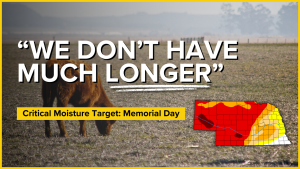
Persistent dryness during Nebraska’s climatologically wettest stretch of the year is raising concerns about how quickly drought conditions could worsen and whether enough rain arrives soon to prevent difficult decisions for ranchers and producers this summer.
Nebraska Extension’s Eric Hunt said the state is entering a critical window where moisture deficits can build rapidly if rain continues to miss the state.
“Us not getting any moisture at all for a 10-to-14-day period is really actually starting to accumulate the deficits,” Hunt said. “That will mean that the drought monitor can change a little bit more quickly as we head into May.”
Much of Nebraska has seen less than a quarter-inch of precipitation so far this month, with some eastern areas receiving no measurable rainfall. While rain chances are expected to improve later this week and into Memorial Day, Hunt said the outlook does not yet point to widespread drought recovery, especially across western Nebraska, where the most severe conditions remain entrenched.
“The best we could hope for between now and the first part of June is that as we get toward next week and through Memorial Day, that we at least are getting enough moisture where things are not getting worse,” Hunt said.
Hunt said Nebraska is transitioning toward an El Niño pattern, which could support more frequent rain chances this summer. However, he cautioned that summer precipitation may be highly uneven, with some communities receiving beneficial rainfall while others remain dry.
“I think the moisture is going to be there for a lot of us this summer, but certainly not all of us,” Hunt said. “We really don’t have much longer in a lot of the western portion of the state, at least on the cool season grasses, to get some moisture before things really turn to the point where they’re not recoverable this year.”
Pasture conditions are already reflecting the strain. Hunt pointed to the latest USDA data showing only 4% of Nebraska pastures rated good or excellent, a number he called unusually low for May. Very poor to poor conditions account for nearly 75 percent of the state’s conditions
“That’s the type of number you see in September or October after you’ve had a major drought,” Hunt said. “The fact that we’re that poor at this portion of the year leads me to think that we don’t have much longer in the western half of the state.”
He added that if meaningful moisture does not arrive by Memorial Day, many producers may face increasingly difficult management decisions for both row crop and livestock operations.